EMERGENCY RESPONSE READINESS
Emergency Response Readiness
When an Emergency Happens, Everyone Should Know What to Do.
Assessment · Roles & Responsibilities · SOPs · Training · Simulation · Documentation
Talk to Us About ERR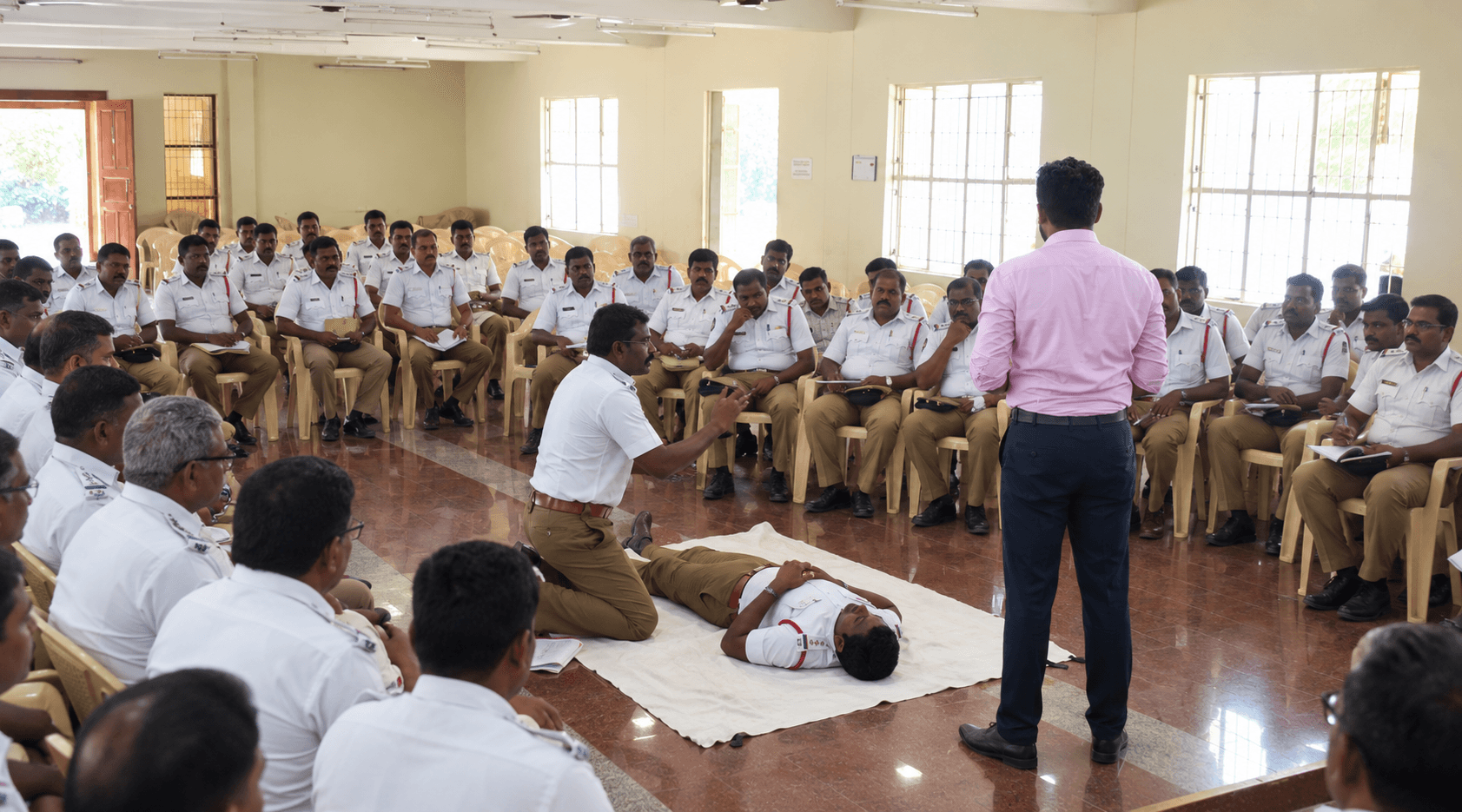
WHEN AN EMERGENCY HAPPENS, WHO DOES WHAT?
Most organisations have people designated for emergencies.
They may have a first-aid team, security personnel, nurses, HR representatives or emergency response members.
But when a real emergency happens, having people is not the same as having a system.
People may panic.
Roles may overlap.
Someone may wait for someone else to act.
The right person may not be available when the emergency occurs.
And valuable time can be lost.
Emergency Response Readiness builds the system around the people.
THE ERR PHILOSOPHY
Everyone Has a Role. Some Carry Advanced Responsibilities.
An emergency-ready organisation is not one where only a few people know what to do.
It is one where:
- Everyone knows their baseline responsibility.
- Selected responders know their advanced roles.
- Leaders know who to activate and how to coordinate.
- Management knows how the system is governed.

So when something goes wrong, the organisation doesn't depend on one individual. The system is designed to continue even when a key responder is unavailable.
FROM PEOPLE TO A RESPONSE SYSTEM
- Assess
- Design
- Train
- Simulate
- Review
- Improve
ERR begins by understanding the organisation before designing the response system.
We assess:
- Nature and distribution of workplace hazards
- Number and distribution of employees
- Existing trained responders
- First-aid facilities and AED availability
- Access to medical care and nearby emergency facilities
- Communication systems
- Shift patterns
- Previous incidents
- Existing emergency roles and reporting structure
- Existing SOPs and emergency procedures
The response structure is then designed around the actual organisation—not a generic template.
BUILDING THE RESPONSE STRUCTURE
ERR creates clear levels of responsibility.
Baseline Awareness
Every employee understands their basic responsibility during an emergency.
First-Aid Responders
Selected personnel receive practical first-aid training.
Advanced Responders
Designated personnel receive advanced BLS and emergency response training.
Coordinators
Coordinate communication, escalation and movement of the response.
Management & Governance
Provides institutional ownership, resources, review and oversight.
The objective is simple:
The right person knows what to do, whom to inform and what happens next.
SOPS THAT HELP PEOPLE DECIDE UNDER PRESSURE
An SOP should make decision-making easier under pressure.
During an emergency, people don't have time to search through files.
ERR develops and structures emergency procedures around the organisation's actual needs.
SOPs can define:
- Who responds.
- Who leads.
- Who communicates.
- Where the casualty should be taken.
- Whom to contact.
- When to escalate.
- What happens next.
The objective is:
Faster, clearer and more appropriate response.
SIMULATION BUILDS RESPONSE MUSCLE
A drill is useful only when it reveals how the system actually performs.
ERR uses scenario-based simulations to test the organisation under changing conditions.
A scenario may introduce:
- An unavailable responder
- Delayed communication
- Missing equipment
- Multiple people requiring assistance
Participants respond using the roles, SOPs and escalation structure established for their organisation.
Mistakes are not hidden. They are documented, reviewed and corrected.
EVERY DRILL SHOULD MAKE THE NEXT ONE BETTER
- Simulation
- Observation
- Reporting
- Correction
- Re-Simulation
After every exercise, critical gaps are documented.
We identify:
- What happened?
- Where did the response fail or slow down?
- Which role, resource or SOP needs correction?
- What must change before the next simulation?
The next simulation tests whether those changes actually worked.
Readiness is not achieved by completing a drill. It is built by improving after every drill.
DOCUMENTATION IS THE BACKBONE
An emergency response system cannot improve if its performance is not recorded.
ERR establishes appropriate documentation for:
- Incident reporting
- Response timelines
- Roles and responsibilities
- Drill observations
- Corrective actions
- Training records
- Equipment readiness
What gets documented can be measured. What can be measured can be improved.
THE GOLDEN CIRCLE DIFFERENCE
We don't build a compliance checklist. We build organisational capability.
ERR is designed to become part of the organisation's operating structure.
- Management must own it.
- Responders must understand it.
- Every employee must know their role.
- The system must be reviewed and improved regularly.
First Aid and BLS form the response capability. ERR builds the organisational system around it.
WHAT DOES “EMERGENCY READY” MEAN?
An organisation is emergency ready when:
- Every employee knows their basic role.
- Designated responders know their responsibilities.
- Escalation routes are clear.
- SOPs are usable under pressure.
- Equipment is available and maintained.
- Communication works.
- The system does not depend on one person.
If one person is absent, someone else knows what to do next.
ERR is not a one-day workshop, a mock drill or a manual. It is a system that becomes part of how an organisation responds.
Preparedness is not a document. It is behaviour.
THE ERR OUTCOME
A workplace where people know their role instead of waiting for someone else to take charge.
- They recognise.
- They communicate.
- They respond.
- They escalate.
- They support.
That is Emergency Response Readiness. A system that works when it matters most.
WHO IS ERR FOR?
- Schools
- Colleges
- Corporates
- Industries
- Hospitals
- Institutions
- Large Workplaces
ERR is designed around the size, risks, people, facilities and emergency needs of each organisation.